
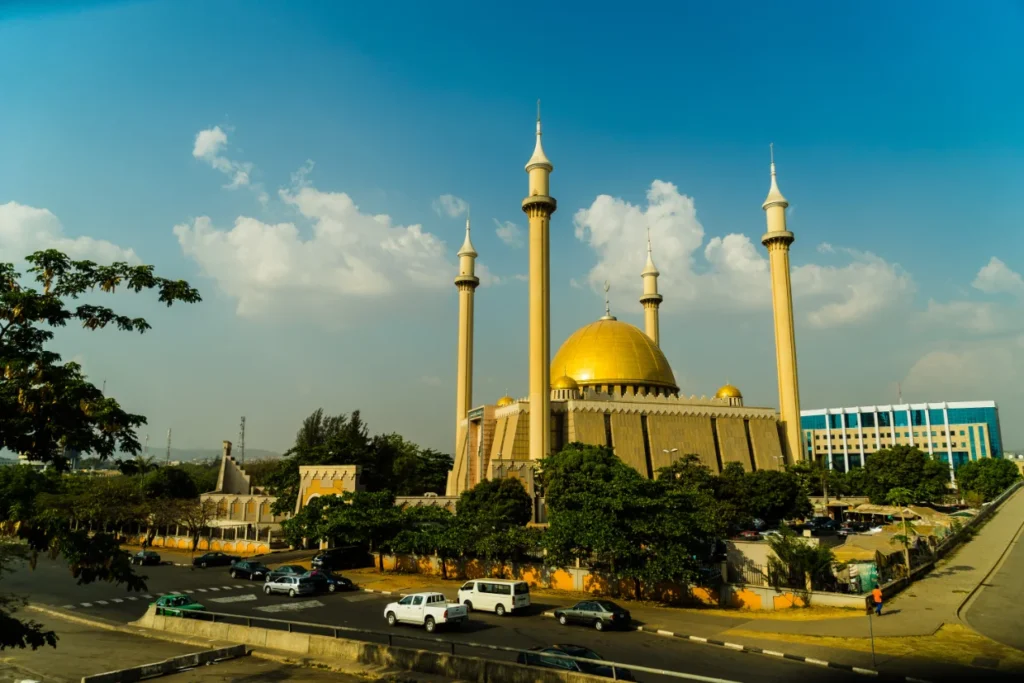
Background and Architectural Marvel
The Nigerian National Mosque stands as one of the most recognizable and magnificent pieces of architecture in the country. Defining the skyline of the Central Business District, the mosque is renowned for its resplendent golden dome that gleams brilliantly under the West African sun. It is flanked by four towering minarets, each reaching a height of 120 meters. Designed by AIM Consultants, the complex is a masterclass in modern Islamic architecture, incorporating intricate geometric patterns, vast courtyards, and beautiful calligraphy.
History and Construction
The decision to construct a National Mosque was inextricably linked to the relocation of Nigeria’s capital from Lagos to Abuja. In the early 1980s, as the new capital was taking shape, the government and religious leaders recognized the need for a central place of worship that would serve the nation’s large Muslim population and represent the country on an international scale. Construction commenced in 1984, funded by contributions from the federal government, state governments, and private donors across the nation. It was designed to stand in architectural conversation with the National Christian Centre, symbolizing religious unity and tolerance in the new capital.
Beyond the main prayer hall, which can accommodate thousands of worshippers, the complex is an educational and administrative hub. It houses a vast library rich in Islamic texts, a religious school, a conference center capable of hosting five hundred people, and the residential quarters for the Chief Imam and the muezzin.
The Visitor Experience
The National Mosque is not exclusively for the Muslim community; it serves as a cultural landmark open to the general public, including non-Muslims, during non-congregational times (outside of regular prayer hours). Visitors are welcome to explore the serene courtyards and admire the intricate interior tiling and grand chandeliers. Dress codes apply—modest clothing is required, and women are expected to cover their heads before entering the complex. Guided tours can often be arranged at the administrative office, providing a deeper understanding of the building’s history and architectural nuances.
Looking for a comfortable base for your visit?
Plan your stay at Chrisvirgy