
Background and Geographical Significance
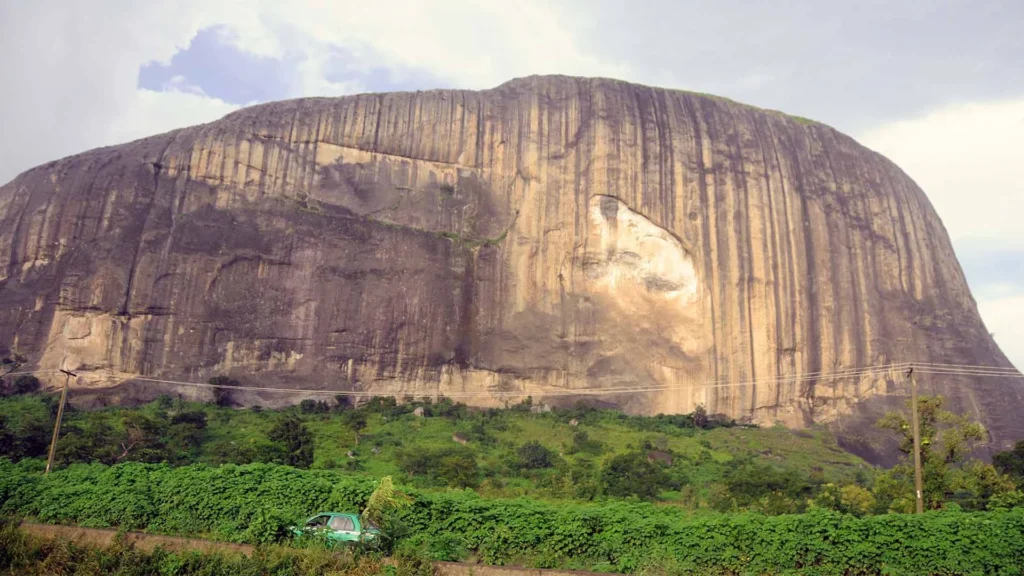
Rising an imposing 725 meters (2,379 ft) above its surroundings, Zuma Rock is a massive igneous intrusion—a gabbro and granodiorite monolith that dominates the landscape just outside Nigeria’s capital. Often referred to as the “Gateway to Abuja from Suleja,” it is impossible to miss when driving along the main expressway. Its sheer size and striking isolation in the relatively flat savannah make it one of the most photographed and iconic natural landmarks in West Africa. Its cultural and national significance is so profound that it was chosen to adorn the back of the Nigerian 100 Naira note.
A Deep Historical and Cultural Context
Long before the modernization of the Federal Capital Territory, Zuma Rock served as a vital sanctuary. For the indigenous Gbagyi (Gwari) people, the rock was a natural fortress. During times of inter-tribal warfare in the pre-colonial era, the surrounding communities would retreat to the base and the hidden crevices of the rock to defend themselves against invading forces. The rock provided an unparalleled vantage point to spot approaching enemies across the plains.
The rock is deeply intertwined with local folklore. The most distinguishing feature of Zuma Rock is the natural contouring on its primary face, which remarkably resembles a human face with defined eyes, a nose, and a mouth. Traditional beliefs hold that this face represents the ancestral deity of the rock, watching over the inhabitants of the land. Furthermore, during heavy rains in the wet season, locals observe water cascading down the exact location of the ‘cheeks,’ leading to the enduring myth of the weeping rock. Another fascinating phenomenon occurs when sliding boulders cause friction at the apex during storms, resulting in sparks that locals traditionally interpreted as the rock’s crown catching fire.
The Visitor Experience
While scaling the rock is restricted to highly experienced mountaineers due to its steep, sheer faces, visiting the base is a popular activity. The surrounding Zuma Rock Resort provides a safe and comfortable environment to view the monolith, take photographs, and enjoy the local scenery. Visiting during sunset offers the most dramatic lighting, highlighting the contours of the “face” in the stone. For guests staying in Kubwa, it serves as an incredibly convenient half-day excursion, bridging modern hospitality with ancient natural history.
Looking for a comfortable base for your visit?
Plan your stay at Chrisvirgy